This is a blog about the native conifers of the Pacific Northwest. It is a companion to the Northwest Conifers site. The blog will focus on timely and interesting details about our conifers, their connections to the rest of the environment, and our connection to them.

Tuesday, February 7, 2017

Why Is the Climate Warming?

Just about everyone realizes that the earth’s climate is warming. If you haven’t seen it, here is the chart on global temperatures released by the National Oceanic and Atmospheric Administration in January 2017:


Source: NOAA

There is some variability up and down, but the trend is clearly up, and quickly accelerating. It doesn’t seem like much, but we can clearly see the effects of the warmer temperatures, including shrinking ice sheets, declining Arctic ice, and retreating glaciers all over the world. As a result of shrinking ice sheets, retreating glaciers and warming oceans, we are seeing rising sea levels. Even people who were skeptical of global warming are coming to realize that the temperature of the earth is rising. Now the question is: What is causing these rising temperatures?

Scientists have investigated several possible causes of warming, but their research has determined that only one cause explains the accelerating rise in global temperatures. The reason that the planet is getting warmer is due to the rise in greenhouse gasses, primarily carbon dioxide (CO2). Popular discussion in the media might lead you to think that the idea that these gasses could lead to rising global temperatures is a recent claim, but this is not the case. This relationship was proposed in the nineteenth century. Scientists were investigating the relationship between CO2 concentrations in the atmosphere and temperature. They theorized that increasing CO2 would cause the temperature to rise. The test of a scientific theory is whether or not its predictions turn out to be true. Laboratory experiments verified that CO2 and other gasses do act as a greenhouse gas. More importantly, we have been conducting a 100 year experiment that tests this theory on the earth itself. Sadly, it has turned out to be true. As atmospheric CO2 levels have increased, so have world temperatures.


A good scientific theory doesn’t just make predictions. We expect that the theory should explain a phenomenon. In this case, we want to know why temperatures increase when CO2 levels increase. Broadly speaking, the greenhouse effect works like this:
  1. The sun warms the surface of the earth.
  2. Some of this heat is radiated back toward space.
  3. Some of the heat that is radiated toward space is absorbed by molecules of greenhouse gasses.
  4. Greenhouse gas molecules then radiate some of this heat back to the earth.


Source: NASA

Now you might wonder, why doesn’t the radiated heat from the earth just pass through the greenhouse gasses like the initial heat radiation from the sun? The answer is where this theory really gets interesting. The radiation from the sun is mostly visible light and ultraviolet radiation. The shorter wavelength of this light passes through the greenhouse gasses. The radiation radiated back toward space is infrared radiation. The wavelength of infrared radiation is longer and more likely to hit the large molecules of greenhouse gases.


Source: NASA

Scientists have also determined the individual wavelengths absorbed by different greenhouse gasses. This enables them to measure how much each gas contributes to the greenhouse effect. You can read about that here.

Finally, research has shown that the reason that greenhouse gasses, and especially CO2, have increased significantly over the last half-century is due to the burning of fossil fuels. If we want to prevent runaway warming in the next century, we need to quickly develop alternative sources of energy.


More Info


The NASA and NOAA websites have enormous amounts of great information on climate change. At least it is still available as of February 6, 2017.

Monday, January 16, 2017

How Do Conifers Survive the Snow?

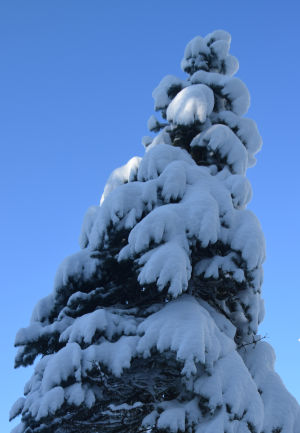
Snow is not friendly to trees, as we have seen, with the recent snow in the Portland area, which brought down limbs and entire trees. We see how destructive snow can be to trees, yet when we go to the mountains we see trees thriving there where the snow accumulates to many feet every winter. How is it that the trees in the mountains survive these mountains of snow?


First, we can notice that the trees growing in the mountains are not the same species as those we typically see growing in the lower elevations. Secondly, we have to remember that trees adapt to the environment that exists where they grow naturally. Several important adaptations have enabled conifers to survive deep snow without limb breakage. 

Conifers growing near the timberline show the most extreme adaptations to heavy snow. If you drive up to Timberline Lodge on Mt. Hood and look at the trees growing there, the first thing you might notice about them is that they grow as narrow spires with very short limbs. Other adaptations include drooping limbs that shed the snow and flexible limbs that bend without breaking when weighted down with snow.  


Subalpine Fir
Perhaps the most iconic of the conifers growing at the timberline is subalpine fir, which adopts the form of the Eiffel Tower. It is one of the more photogenic trees at the timberline, with tall spires pointing skyward. It avoids limb breakage by keeping its limbs close to itself. The short limbs don’t collect much snow on them, and the snow that does collect doesn’t get much branch-breaking leverage.

Pacific silver fir has slightly longer limbs, but they are pointed down where they can shed snow. Even when snow accumulates on the limbs, their orientation prevents breaking.


Pacific Silver Fir
Another strategy is to just bend under the burden of the snow. Mountain hemlock is fairly adept at this technique. It also tends to have shorter upper limbs than many other conifers. In the most extreme conditions, mountain hemlock has another trick: It stays low. At the highest elevations it grows as a low shrub. The weight of the snow can bend it to the ground, where it stays until the snow melts in the spring. This bendable habit also gives mountain hemlock an alternate way to reproduce. Limbs weighted down to the ground can take root. You can see patches of mountain hemlock growing near the timberline that reproduce in this way.

Whitebark pine is even more bendable than mountain hemlock. The branches of whitebark pine simply bend with the weight of the snow. In fact, its twigs are so bendable that you can tie one in a knot. That is one way to distinguish it from western white pine. Like mountain hemlock, whitebark pine branches can also take root when forced to the ground by snow.


Mountain Hemlock
Limber pine, which grows in the Wallowas and Rocky Mountains, is a close relative of whitebark pine. Limber pine is the king of bendability. Just in case you didn't know, its common name and scientific name (Pinus flexilis) both describe this feature. 

Conifers also benefit from the snow. Besides the obvious benefit of water from melted snow, the snow is a good insulator. It keeps the ground and roots from freezing in winter. Low-growing trees are also covered and protected from cold temperatures.

______________

See also
How Do Conifers Survive the Cold?
Northwest Conifers: High-elevation Conifers
USFS: Mountain hemlock (Tsuga mertensiana)
USFS: Whitebark pine (Pinus albicaulis)


Friday, January 13, 2017

How Do Conifers Survive the Cold?

Snow on Noble Fir


December is the month of the fir, when it stands resolute, defying the wind and cold.  May is the month of the oak, when it springs to life in an outburst of vivid green.  October is the month of the Maple, when it blazes with the glory of the sun.

But in December, when the fickle oak and failing maple stand barren and leafless in the deepening cold, the fir flourishes, spreading its verdant needles in a steadfast display.  Even when winter covers its branches with snow, underneath the fir endures, a faithful testament to the promise of life.
Ken Denniston - December 1991


The recent cold weather in Oregon got me thinking about just how conifers are able to survive freezing temperatures. Even in the mountains where temperatures drop well below 0° Fahrenheit, conifers endure the cold, often showing no ill effects. When temperatures warm in spring, they, in turn, spring to life and put on new growth.

Ice on Douglas Fir
Freezing is not good news for most living things. It kills many plants and most animals. When living cells turn to ice, they are usually destroyed. Frost kills many crops and other plants. How is it, then, that some trees can survive the freezing cold temperatures of winter?

If you search the Internet and have the patience to wade through some very technical scientific papers, you will find a mountain of information about conifer cold hardiness. Here is a short, summary of what I was able to find and unscramble.

Conifers have developed two mechanisms to deal with winter cold: Freezing tolerance and freezing avoidance. 


Freezing tolerance: Plant cells can tolerate freezing by moving water out of the cell where it freezes without damaging the cell. The concentrated sap in the cell has a lower freezing point and remains in liquid form. This process also leaves the cells dehydrated. To survive, they must also be tolerant of dehydration.

Freezing avoidance: Plant cells can avoid freezing using a process called supercooling. This is a process in which water drops below its freezing point of 32° F. without turning to ice. How is this possible? Normally, when water freezes at 32°, it requires a seed particle. The ice crystals can then begin to form around the seed. This seed could be a tiny spec of some impurity. Water with no impurities can cool to about -40° and still remain liquid. Plants survive by maintaining pure water inside their cells.

Of course, there are limits to how well these strategies can protect conifers from freezing cold. This is why you won’t find any conifers growing on the north coast of Alaska.  

Not all conifers are equally cold hardy. You will see the cold hardy ones growing at the timberline in the mountains. Most conifers that you see growing at lower elevations cannot survive the cold temperatures near the timberline in the mountains. The US Department of Agriculture has developed a hardiness zone system and mapped these zones for the US, shown on the map below.

Even cold-hardy conifers can be damaged by extreme cold. The trees acclimate to the cold in the winter, but rapid temperature changes can still cause damage. New growth on trees and seedlings are more vulnerable to freezing damage. If a cold snap comes in the spring after new buds begin to grow, they can be killed. This happened to the new growth on many subalpine firs around Mt. Hood in the spring of 2016.

Note that there is considerable genetic variability in cold hardiness within a species. Trees adapt to the conditions where they grow. For example, Douglas firs growing at 5000 feet on Mt. Hood are more cold hardy than those growing in the valleys of the Coast Range. If you gather seeds from the low-elevation trees and plant them up at 5000 feet in the Cascades, they will not be able to thrive in that cold environment.


Hoyt Arboretum - January 12, 2017
_________________
More info.
“Mechanisms in Frost Survival and Freeze-Damage in Nature” by Marja-Liisa Sutinen, et al.  in Conifer Cold Hardiness, Ed. by Francine J. Bigras and Stephen Colombo, P. 90ff. Available here.