This is a blog about the native conifers of the Pacific Northwest. It is a companion to the Northwest Conifers site. The blog will focus on timely and interesting details about our conifers, their connections to the rest of the environment, and our connection to them.

Wednesday, December 17, 2014

Popular Christmas Trees

Douglas fir
Do you have your tree yet? Here is a quick guide to popular Christmas trees available in the Portland area.

Native Oregon trees

Douglas fir (Pseudotsuga menziesii) The #2 Christmas tree in US, #1 in Oregon. Soft, thin needles.

Grand fir
Grand fir (Abies Grandis)  Flat needles. Great aroma and good needle retention.

Noble fir
Noble fir (Abies Procera) Stiff branches with upturned needles. Nice form. Good needle retention.


Non-natives

Nordman fir
Nordman fir (Abies Nordmanniana) Native to S. Europe. A good tree for people with allergies. Good needle retention.

Fraser fir


Fraser fir (Abies fraseri) Native to Tennessee. Good needle retention and scent.


Scots pine
Scots pine (Pinus sylvestris) Native to Europe. The #1 Christmas tree in the US. Great needle retention and scent.


For a tour of these and other Christmas trees at Portland's Hoyt Arboretum, see Christmas Trees at Hoyt Arboretum.


A Brief History of Christmas Trees

Early Europeans used evergreen boughs to decorate their homes at the winter solstice.
1500s  Christmas trees decorated in the town square in the capital of Latvia. According to legend, Martin Luther first put a decorated tree in the home.
1600s  Trees commonly decorated with apples in Germany.
1700s  Edible ornaments on trees in Germany. First record of lit candles on trees in France.
1800s  Christmas trees introduced in US by German settlers.
1846  Queen Victoria and family sketched sitting around a Christmas tree, leading to its popularity in England.
1851  First Christmas trees sold in US at a market in NY.
1853   First Christmas tree at the White House.
1882  First electric lights on a Christmas tree by Edward Johnson, protege of Thomas Edison.
1890s  Glass ornaments arrive in US from Germany. Larger trees become popular.
1901  First Christmas tree farm in US.
____________

More information


Tuesday, October 28, 2014

Oregon's Rare Cypress

Trailhead
The Modoc cypress (scientific name Cupressus bakeri) is one of Oregon's rarest native conifers. It grows only in about 10 groves in southwest Oregon and northern California. Cypress trees don’t normally grow in cool or wet climates, and true to character, the Modoc cypress favors dry locations. However, it tolerates cold better than other cypresses, growing farther north than any other cypress in North America.

The Flounce Rock grove is the most northern site of Modoc cypress, at the top of a 4000 foot peak near Highway 62, north of Medford. I visited this site last week and took photos of the trees there. 


Meadow at Flounce Rock Grove


After driving almost seven miles of gravel roads, I found the parking area at the end of the road near Flounce Rock. A sign next to an opening in a wood rail fence marks the trail leading to the cypress grove. This short trail leads ¼ mile through mixed conifer woods and across a meadow to the Modoc cypress.


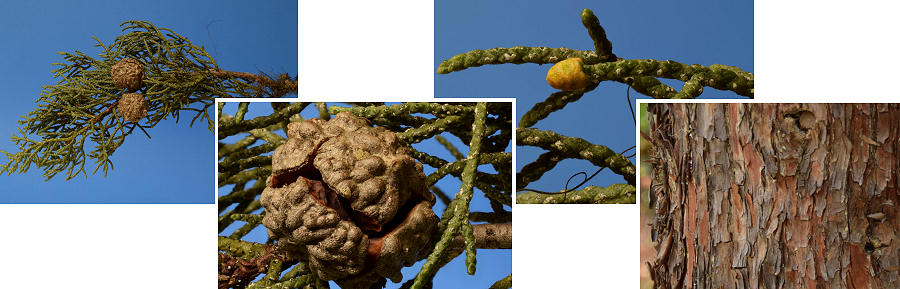
This cypress has gray-green leaves that cling to the stem forming a round covering. The tiny scale-like leaves have distinctive dots of white resin.  The round cones look like Alaska cedar or Port Orford cedar cones, but Modoc Cypress cones are much larger, up to an inch in diameter. The yellow pollen cones grow at the tips of twigs. The thin bark is red on young trees, turning gray and peeling on larger trees.
Modoc cypress is usually a fire-dependent species like knobcone pine. The cones remain closed and on the tree for years until a wildfire causes them to open and release the seeds, which readily germinate on bare soil left by the fire. One exception to this fire dependency is the grove at Flounce Rock, where new seedlings sprouted after trees were blown down in a wind storm.

Seedling
Although Modoc cypress is usually distinguished as the only cypress native to Oregon, The Oregon Flora Project (oregonflora.org) lists two other California species found to be growing in natural stands in Oregon: MacNab's cypress (Cupressus macnabiana) and Sargent cypress (Cupressus sargentii). Cupressus is the genus name of the cypresses. However, some botanists have proposed placing all of the cypresses of the Americas in a new, separate genus. They called this genus Hesperocyparis, which means “western cypress.” If this change is accepted, all of the Oregon native cypresses would be in this new genus and Modoc cypress would be Hesperocyparis bakeri. The species name honors California plant explorer Milo Baker, who discovered the species in 1898. The common name of the species comes from the Modoc tribe, native to the same area as their namesake tree.


More information
Northwest Conifers entry for Cupressus bakeri:
The Gymnosperm Database entry for Cupressus bakeri:
Checklist of Oregon cypress family trees at Oregon Flora Project:
“Cypress Species in Oregon” by Frank Callahan in “Kalmiopsis,” Vo. 20, an interesting account if the discovery and sightings of native cypress:

Thursday, August 28, 2014

Northwest Conifers Quick ID Guide

New at nwconifers.com: Have you always wanted a tree guide that you could take with you in the woods? I've made a Northwest Conifer Quick ID Guide that you can print and put in your pocket. You can download a PDF or Word version here: http://nwconifers.com/info/quick.htm