|
| Wildwood Trail in Forest Park |
"I am alarmed when it happens that I have walked a mile into the woods bodily, without getting there in spirit. In my afternoon walk I would fain forget all my morning occupations, and my obligations to society. But it sometimes happens that I cannot easily shake off the village. The thought of some work will run in my head, and I am not where my body is; I am out of my senses. In my walks I would fain return to my senses. What business have I in the woods, if I am thinking of something out of the woods?" - Walking, Henry David Thoreau
Do you enjoy hiking? What is it about the experience that you enjoy? Is it the challenge of reaching the top of a mountain or the goal of reaching some scenic destination? Is it the exhilarating feeling you get from the exercise or the social aspect of being with friends? In my youth, I considered hiking to be the initial and easy part of conquering a mountain. I remember one occasion when we met some people who were “just hiking.” No one in our group could figure out why they were even there. However, the next day after the climb, I hiked out with two other people. One of them insisted that we maintain a distance of at least 200 yards between ourselves. This was my introduction to a new dimension of hiking, one with a focus on what you see and hear on the hike.
 |
| Starflower |
That hike was the beginning of a new quest: a different approach to hiking that focuses on what I now call mindful hiking, that is, hiking with the focus of your full attention on the present experience of the natural environment. Well, how do we manage to engage in mindful hiking? As a first step it requires excluding distractions from cell phones, portable music players, and other electronic gadgets. Other people can be a distraction, talking about the movie they saw, the restaurant where they had lunch yesterday, their favorite football team, or the latest middle-east crisis. But the most insidious distractions are the silent distractions of the mind — the project you’re working on at work, the trip you’re planning next month, the game you watched last night, the boat you want to buy. Becoming mindful of your present environment requires that you remove or ignore these distractions.
So, how do we do overcome these distractions? Well, we can control many of the physical distractions. We can turn off the cell phone and put away the music player. The mental distractions are more difficult. You can’t focus on not thinking about them. That, too, is a distraction. The only strategy is to fix your attention of the present experience of the natural environment — the shape and color of the leaves on the trees, the way the light filters through the trees, the way the branches sway in the wind, the sound of the call of the chickadees and nuthatches, the texture of the bark on the trees, the moss and the ferns growing along the trail, the smells of the woods and wildflowers.
 |
| Townsend's Chipmunk |
Hiking itself can also be a distraction, especially if the trail is rough and demands your attention, or you are focused on the athletics of hiking. The answer is to slow down, pay more attention to what you encounter on the journey and less attention to getting to the destination. Henry David Thoreau and John Muir both recommended sauntering over walking and hiking. Better yet, just stop. The most rewarding hikes are ones where you stop to observe a bird foraging in the understory or look closer at a favorite wildflower growing along the trail. Sometimes the best way to observe wildlife is to stop, sit quietly and wait for it to come to you.
 |
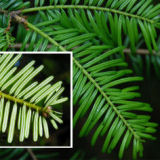
Pacific Silver Fir Pollen Cones
|
One final distraction can be the most difficult one to avoid. I call it the self-awareness distraction. It’s what happens when you think to yourself, “Hey, I’m focusing on nature, now.” When you do that, you stop focusing on nature and start focusing on yourself focusing on nature. Mindfulness described in certain types of meditation does focus on our own sensations and perceptions, often an attentive focus on breathing. But mindfulness of nature has its focus elsewhere. That’s not to say that these approaches to mindfulness in meditation are wrongheaded. It’s just that mindfulness of nature falls apart when it takes this turn and becomes focused on itself. Whatever the benefits are of this type of meditation, they interrupt the focus on nature and ultimately fail to reap the rewards of mindful attention to nature. So stop thinking about breathing. Your body will manage that without you thinking about it. You can be free to focus on what you see, hear and smell around you. Focus on that squirrel you hear scrambling up a tree. See if you can spot it looking down at you.
Mindfulness of nature involves a focus on the natural environment, but it is a particular kind of focus. This focus on nature is characterized by curiosity, knowledge, and wonder. Almost everyone at least has some appreciation of the beauty of nature. But this level of appreciation can be quite superficial. Curiosity can take us deeper. It leads us to look more closely and to notice new details and relationships.
 |
| Pygmy Owl |
Curiosity, when it is exercised, produces knowledge. The more you learn about the natural world, the more nature draws you in and the more curiosity and then wonder drive you to learn more and increase your attention to new observations of even more subtle distinctions. For instance, when you see cones under a conifer, they won’t mean much to you until you learn the differences between Douglas fir cones, hemlock cones, and spruce cones. When you learn to recognize the call of a chickadee or a nuthatch, then whenever you hear one you will feel like you are meeting an old friend. These differences help you identify the trees and birds, but noticing the differences also deepens your experience of these natural wonders.
The more you learn, the more your attention to nature will be rewarded. The reward is the joy of the experience of beauty. It brings healing to the mind that transcends psychotherapy, drug therapy, and perhaps even inward meditation. So when you are out hiking, be mindful of your environment. You will be rewarded.
"Nature is ever at work building and pulling down, creating and destroying, keeping everything whirling and flowing, allowing no rest but in rhythmical motion, chasing everything in endless song out of one beautiful form into another." - Our National Parks, John Muir